
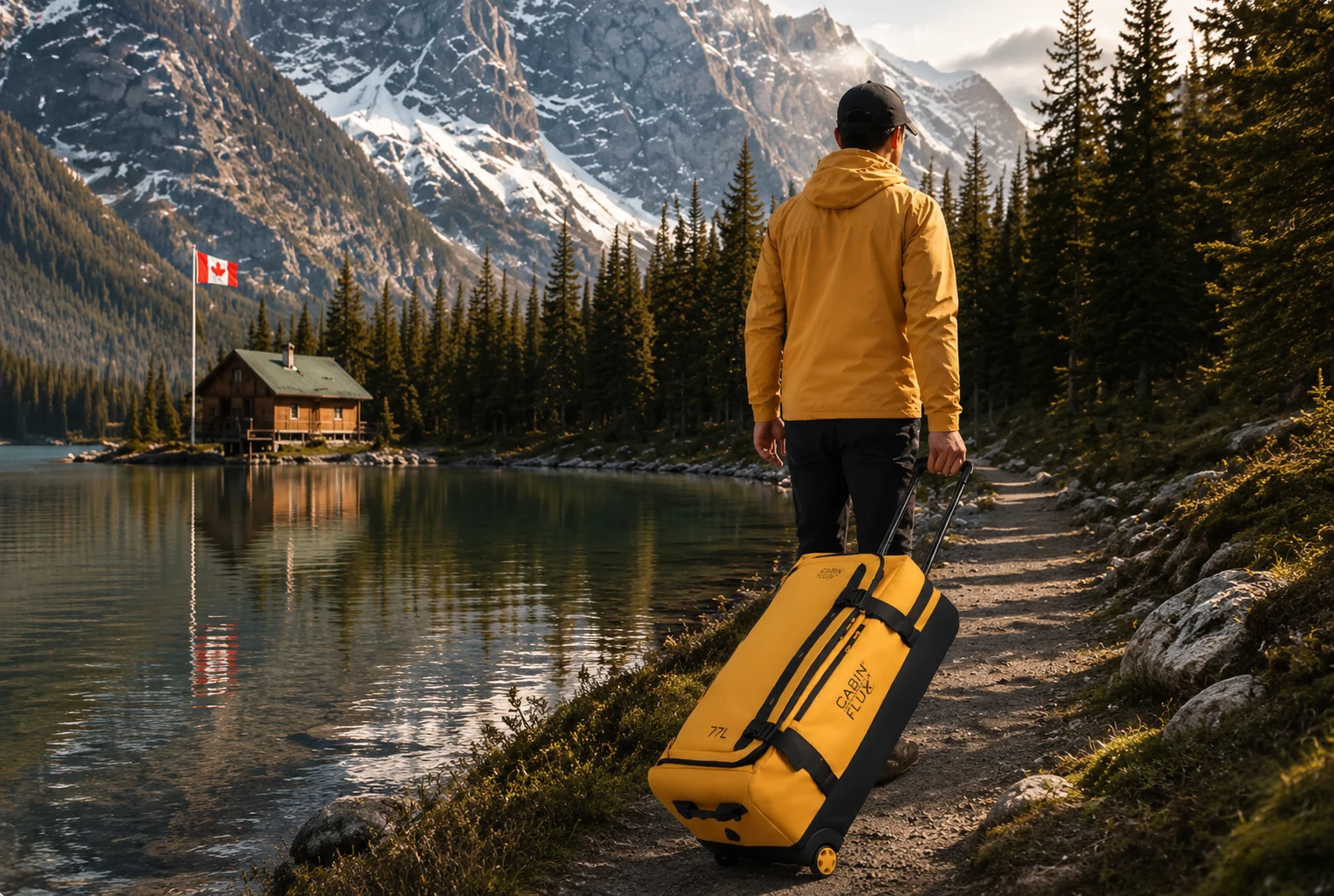
Neither one is "better" — they solve different problems. A duffle carries more per kilogram, squeezes into overhead bins and car boots, and stores flat between trips. A suitcase protects fragile contents, organises more neatly, and rolls with less effort. The right answer depends on what your trips actually look like.
The comparison at a glance
| Factor | Duffle bag | Suitcase |
|---|---|---|
| Capacity per kg | Excellent — our Rolling Duffle carries 120 L at 2.7 kg | Good — a 29" case carries ~108 L at 2.8 kg |
| Protection | Soft body — fine for clothing and gear | Rigid frame — better for fragile contents |
| Mobility | Shoulder, grip or wheels (on wheeled models) | Effortless 360° spinner rolling |
| Storage at home | Folds flat or rolls up | Takes closet space year-round |
| Packing style | One big flexible compartment — swallows bulky items | Structured halves — keeps everything in place |
| Rough travel | Thrives — truck beds, boat decks, roof racks | Prefers pavement and terminals |
| Best for | Gear-heavy trips, moving, sports, expeditions | Business travel, city trips, fragile items |
When the duffle wins
A duffle is the highest-capacity way to move soft goods, full stop. With no rigid frame, almost all of its weight budget goes to carrying — which is how a 120-litre bag can weigh 2.7 kg. The soft body also forgives the real world: it compresses into a packed car boot, rides a roof rack, and gets thrown onto a boat deck without complaint.
- Big, awkward loads: sports kit, camping gear, a season's wardrobe — one open compartment takes what structured cases refuse.
- Rough handling: ballistic fabric and waterproof zippers shrug off what would scratch or crack a shell. Our Buffalo series is built for exactly this.
- Storage: when the trip ends, the Rolling Duffle 120L folds flat into its own pouch. A suitcase never gets smaller.
When the suitcase wins
Structure has its own payoffs. A suitcase holds its shape, so shirts arrive less crumpled, and anything breakable travels inside a protective frame rather than a fabric bag. Spinner wheels change long travel days: a case glides beside you through a terminal with two fingers, while a shoulder-carried duffle gets heavier by the hour.
- Business and city trips: pressed clothing, a laptop, tidy internal organisation — a case like the 1.9 kg Spirit C-Lite 20" keeps everything exactly where you packed it.
- Fragile contents: camera gear, gifts, bottles — rigidity is the whole point.
- Effortless mobility: smooth floors reward wheels; your shoulders stay free.
Rule of thumb: pack what the trip demands. Gear and rough roads say duffle; meetings and marble floors say suitcase.
The middle path: wheeled duffles
The categories have quietly merged. A wheeled duffle bolts a trolley handle and wheels onto a soft body — duffle capacity you can roll like a case. Our Buffalo 45L is a 21" cabin-sized example: duffle packability on the way out, suitcase-style rolling through the terminal. And the flagship Rolling Duffle 120L scales the same idea to a full expedition load — 120 litres, four carry modes, then flat-folded into a cupboard at home.
The short version
Choose a duffle for capacity, rough travel and easy storage. Choose a suitcase for protection, organisation and effortless rolling. If you genuinely need both, a wheeled duffle is the honest compromise — and it's the category our Buffalo series was built for.
Frequently asked
Can a duffle bag be a carry-on?
Yes — if it fits your airline's cabin envelope. The Buffalo 45L at 53 × 32 × 26.5 cm fits most major-airline carry-on limits, and soft sides are more forgiving in the sizer than a rigid shell. Check the size rules for your carrier before you fly.
Is a duffle harder to organise?
Out of the bag, yes — one big compartment is freedom and chaos at once. Compression packing cubes solve it: pack by category, stack the cubes, and a duffle becomes as ordered as any case.
Which lasts longer?
Both, when built honestly. Fabric duffles have fewer parts to break — no wheels-and-frame system to bend — while good cases protect their own mechanisms. Every CABIN FLUX bag and case carries the same 3-year warranty, so the choice is about your trips, not durability.